
Looking for API to MCP Lifetime deal?
How to get the API to MCP lifetime deal
If you would like to buy a lifetime deal on API to MCP, make a request here. When the deal is live, you will receive an email from us notifying you about it.
You can increase the chances of getting this lifetime deal by sharing this page with your friends and colleagues and encouraging them to make a request for API to MCP LTD.
The more requests we receive, the better the chances of securing the deal for everyone.
Request
⇢
Share
⇢
Get Notified
Share with your friends to reach the goal!
Share and get your friends to request this deal to increase the chances of getting this lifetime deal
What is API to MCP?
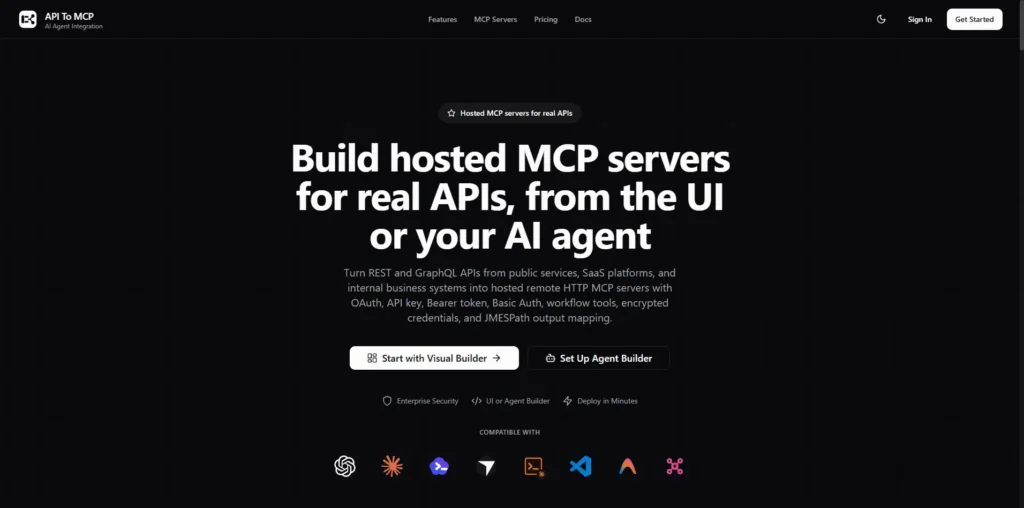
API to MCP is a developer platform that converts REST and GraphQL APIs into hosted Model Context Protocol (MCP) servers, making them accessible to AI agents such as ChatGPT, Claude, Cursor, Codex, and VS Code.
It eliminates the need to manually build MCP integrations, allowing developers to expose existing APIs as AI-ready tools in just a few minutes.
API to MCP covers several parts of the AI integration workflow, from connecting APIs with OAuth, API keys, and bearer tokens to creating workflow tools, mapping API responses, testing integrations, and deploying secure hosted MCP endpoints.
API to MCP Plans and Pricing
API to MCP Use Cases
Connecting APIs to AI Assistants: Developers can expose existing APIs to AI assistants like ChatGPT, Claude, Cursor, Codex, and VS Code. This allows AI agents to securely access and interact with real-world applications through the Model Context Protocol.
Building AI-Powered SaaS Integrations: SaaS companies can quickly make their products AI-compatible by converting their APIs into hosted MCP servers. This enables customers to automate tasks and interact with software using natural language.
Internal Workflow Automation: Engineering teams can connect internal APIs to AI agents that automate repetitive business processes, retrieve company data, execute workflows, and assist employees without requiring custom integrations.
Rapid MCP Server Deployment: Instead of manually developing and maintaining MCP servers, developers can generate, configure, and deploy them using a visual interface. This significantly reduces development time while simplifying authentication and API management.
AI Agent Development: AI engineers can create intelligent agents that interact with multiple third-party services through standardized MCP endpoints. This makes it easier to build assistants capable of performing actions across different applications without writing custom connectors for every API.
Who is API to MCP ideal for?
SaaS Companies: API to MCP is ideal for SaaS businesses that want to make their products accessible to AI assistants without building custom MCP infrastructure. By converting existing APIs into hosted MCP servers, companies can quickly enable AI-powered workflows for their customers.
Software Developers: Developers can use API to MCP to transform REST and GraphQL APIs into AI-ready endpoints with minimal effort. This eliminates the complexity of manually implementing the Model Context Protocol and accelerates AI integration projects.
AI Engineers: AI engineers building intelligent agents can leverage API to MCP to connect language models with real-world applications. Standardized MCP endpoints make it easier to create AI agents capable of retrieving data and performing actions across multiple services.
Enterprise Engineering Teams: Organizations with internal APIs can use API to MCP to securely expose business systems to AI assistants. This enables employees to automate workflows, access company data, and improve operational efficiency through natural language interactions.
Startups Building AI Products: Startup founders and lean engineering teams can rapidly launch AI-enabled applications without investing significant time in infrastructure development. API to MCP provides a faster path to integrating AI assistants with existing products, allowing teams to focus on building customer-facing features instead of backend integrations.
API to MCP Key Features
REST API to MCP Server Conversion
GraphQL API to MCP Server Conversion
Hosted MCP Server Deployment
Visual MCP Builder
AI Agent Builder
OAuth and API Key Authentication Support
Custom Tool and Workflow Creation
MCP Endpoint Testing and Debugging
Multi-API Integration Support
ChatGPT, Claude, Cursor, and VS Code Compatibility
Composio: one of the leading platforms for connecting AI agents to hundreds of APIs with built-in MCP support and authentication management.
Pipedream: a powerful automation platform that lets developers build API workflows and expose them to AI agents using MCP-compatible integrations.
Nango: a developer-first API integration platform that supports MCP servers, OAuth management, webhooks, and production-grade API integrations.
Gram: an API-to-MCP platform that automatically generates MCP servers from REST APIs, making it easy to expose services to AI agents.
Glama: a hosted MCP server platform that provides managed MCP hosting and gateway access for AI applications without requiring developers to manage infrastructure.
API to MCP is a strong choice for developers and SaaS companies looking to make their APIs AI-ready without building MCP infrastructure from scratch. If you need broader AI integrations, workflow automation, or managed API connectivity, the alternatives above are also worth considering.
API to MCP alternatives and competitors
Why we can get API to MCP
Be the first to know when API to MCP LTD goes live!
At Prime, we do the impossible very often!
What LTD fans say about Prime Club:
Prime Club is my go-to for LTDs. Dev curates quality lifetime deals, including big brands like SpyFu. Excellent platform and great value!”
Prime Club definitely has a bright future and eventually will become the most trustable brand in the Lifetime deal community.
You’ll be the first to know the moment they launch!
Request for a API to MCP lifetime deal
Be the first to know when we launch this deal
- Terms of use
- Privacy Policy
- ©2026 | Crafted with love